
Q: I’ve seen them spelled, “Spaetzle” or “Spatzle” or “Spatzli,” so which is it?
That depends. In German, they are called “Spätzle.” They are spelled with the German Umlaut (ä), a letter that does not exist in English, and the word is always capitalized, as all German nouns are. When umlauts are Anglicized (or Americanized), the umlaut is replaced with an “e,” so spaetzle is a correct Anglicization. Since the “ae” combo looks a bit awkward, some people just drop the “e.” That’s o.k. but in German the “ä” sounds like “ay” while the “a” sounds more like “ah.” The “i” ending indicates the Swiss spelling, and they pronounce the last syllable “lee” rather than “lah.” I know, too much information. But you asked.
Q: I’ve heard Spätzle described as “noodles” and as “dumplings.” What are they?
A: In our opinion, Spätzle clearly fall in the “noodles” category. But, unlike most noodles you may be more familiar with, the beauty of Spätzle is in their unevenness. As they say about snowflakes, no two Spätzle look exactly alike. It’s their uneven surfaces that makes the sauces really stick to them.
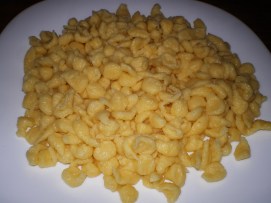 That said, there is a Bavarian creation known as “Knöpfle” that look a bit more like what you might call a small dumpling. “Knöpfle” (Knoi-pflay), or buttons, are pictured on the left.
Even though when you look up “Knöpfle” on Wikipedia it says “See Spätzle,” we say they are at best distantly related. I mean, when you see Knöpfle, do YOU see Spätzle??? We didn’t think so.
Q: How are Spätzle made?
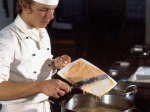
The short answer is, that depends upon whom you ask! The traditional way to make them is with a board and a knife or scraper (Brett und Schaber). The dough is slapped on to a hand-held cutting board, and the knife is used to cut thin strips of dough that are dropped one at a time into the boiling water. There is also a tool known as a Spätzleshobel that looks like a grater with an open box on top. The dough is filled into the box, and the Spätzle are created by moving it back and forth over the grater which is held over the pot of boiling water. Purists say the board and scraper method is preferable since you can create different shapes of Spätzle; however, it is possible to achieve more or less the same result with a press… and it’s a lot easier to use.


Q: Can you eat them plain or do you have to serve them with something else?
The Swabians eat everything with sauce. The saying goes, “Big and strong through Spätzle with sauce!” (It’s a catchy rhyme in German but loses something in translation.) We’ve suggested a few of the traditional ways Spätzle are served (see “Fro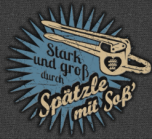 m Oma with Love♥” on our home page.) They are usually served with a roast and gravy, with goulash, or with any meat accompanied by a gravy. Vegetarians can try them with lentils (just leave out the usual Wurst and/or smoked ham) or with sauerkraut or baked with cheese. If you ask our kids, they will say they taste awesome right out of the pot, just plain. It’s really up to you and your imagination.
Q: Are they always boiled?
That’s how they are made and usually reheated and served, but many people like to fry them up when they reheat them. A family favorite is fried Spätzle with ham and egg (Schinkenspätzle) or baked with cheese and onions (Kässpätzle).
Q: Do they come in different varieties?
Usually not. But you will also find whole wheat, tomato or spinach versions. That said, nowadays you might come across all sorts of different “flavors” (purists will scoff!) and we are doing some experiments of our own. Stay tuned!
 Carolina Spätzle